

Diagnosis & Treatment
Understanding your scoliosis is the first step toward effective management. Learn about how scoliosis is diagnosed and the medical pathways available to treat it.
Educational information only · Not a diagnosis or a substitute for personal medical advice
How Is Scoliosis Diagnosed?
A healthcare professional usually begins with a medical history and physical examination.
They may examine:
- Posture and body alignment
- Shoulder and hip symmetry
- The back while standing
- The spine during forward bending
- Possible neurological findings
A scoliometer may sometimes be used during a physical examination to estimate trunk rotation.
When scoliosis is suspected, an X-ray is commonly used to evaluate and measure the spinal curve.
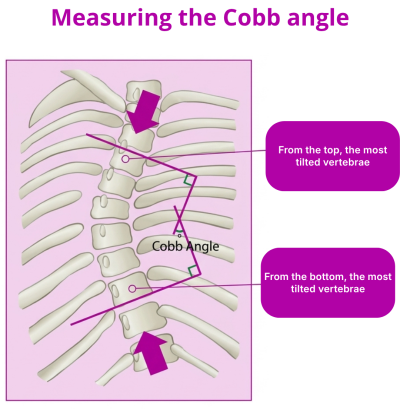
The curve is measured using the Cobb method, producing a measurement in degrees called the Cobb angle. A curve greater than 10 degrees is generally considered scoliosis.



Important: A physical screening test alone should not be treated as a definitive diagnosis. Patients and families must seek professional help from licensed physicians and health care professionals.
Diagnosing Scoliosis
A scoliosis diagnosis can feel overwhelming, but it doesn’t define you. Whether you’re facing bracing, surgery, or uncertainty about what comes next, we’re here to answer your questions and help you understand your options.
How Is Scoliosis Treated?
Not everyone with scoliosis needs active treatment.
Treatment depends on factors such as:
- Age
- Growth remaining
- Size and location of the curve
- Whether the curve is changing over time
- Symptoms
- The underlying cause of the scoliosis
Observation
For some people, especially those with milder curves, the healthcare team may recommend regular monitoring rather than immediate treatment.
The purpose is to watch for changes as the person grows or as the condition changes over time.
Bracing
For some growing children and adolescents with curves at risk of progressing, a back brace may be prescribed.
The goal of bracing is generally to slow or stop further progression of the curve while the child is still growing.
Physical Therapy and Scoliosis-Specific Exercise
Physical therapy may be included in an individualized treatment plan. Scoliosis-specific exercise approaches may be used by appropriately trained physical therapists.
Exercise can also support general physical fitness, strength, mobility, and quality of life. Treatment should be tailored to the person’s specific condition rather than based on generic online exercises.
Surgery
For selected patients with more significant or progressive curves, surgery may be considered.
The type of surgery and decision to operate depend on factors such as the size and pattern of the curve, age, growth, progression, symptoms, and overall clinical circumstances. Spinal fusion is one surgical procedure used to correct and stabilize certain curves.
Living with Scoliosis
Living with scoliosis can bring unique challenges, but with the right support and care, you can maintain an active, fulfilling life. Learn about treatment options, daily management, and ways to improve your quality of life.
When Should Scoliosis Be Assessed?
If you notice possible signs of scoliosis in yourself or your child, seek assessment from a qualified healthcare professional.
A healthcare professional can determine whether an abnormal spinal curve is actually present, assess its severity and cause, and recommend appropriate monitoring or treatment when necessary.
For children and adolescents, evaluation may involve a pediatrician, orthopedic surgeon, or other appropriately qualified healthcare professional. Physical therapists may also be part of the multidisciplinary care team.
Remember:
You do not have to figure out your diagnosis from a photo or screening test alone.
A visible asymmetry can have different causes, and a forward-bend test cannot replace professional assessment and appropriate imaging.
See a qualified healthcare professional when scoliosis is suspected.
Patient brochures from the Scoliosis Research Society
For more detailed patient education, visit the Scoliosis Research Society’s official patient-brochure page. The original publications remain hosted by SRS, so visitors can access the source material directly.
Medical Assistance
Explore the existing directory of government, LGU, nonprofit, PWD and crowdfunding resources. Check each provider’s requirements and current program details before applying.
Before you apply
Prepare documents and confirm the details of each program. Requirements and eligibility may differ by provider.
- Review the provider’s current eligibility criteria.
- Check the required documents and application steps.
- Confirm program dates, availability and contact details.
- Use only official channels to submit personal documents.
Wherever you are in your scoliosis journey, you belong here.
Whether you’re newly diagnosed, supporting a child, living with scoliosis as an adult, or simply looking for reliable information—we’re here to help you find your next step.